
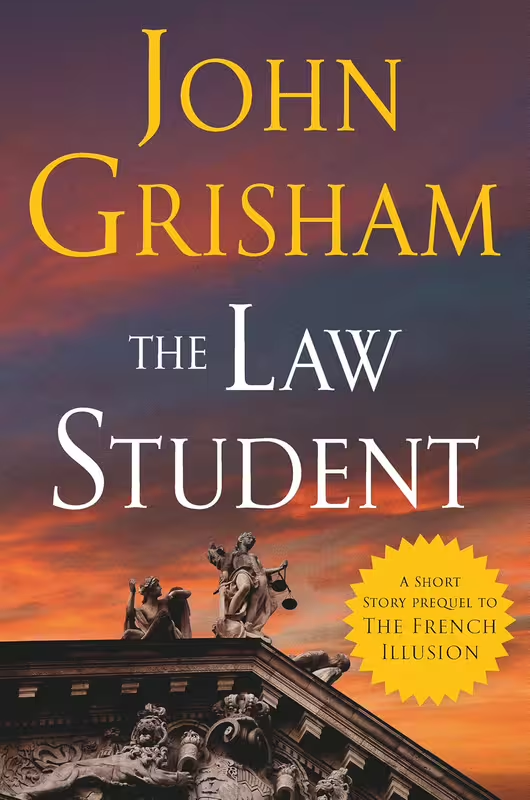
The Law Student by John Grisham
The Law Student by John Grisham is a compelling short story that introduces readers to Stuart Nash, a young man whose carefully planned future takes an unexpected turn. A college football player in a small North Carolina town, Stuart has spent much of his life following a familiar path, one shaped by expectations, ambition, and the promise of a successful athletic career. But a deeply personal encounter with a family struggling to obtain justice forces him to look at his future differently.
What begins as a difficult and emotional experience becomes a turning point. Stuart starts to see the law not simply as a profession, but as a way to make a meaningful difference in people's lives. His decision to pursue law school opens the door to an entirely new chapter, one that will eventually shape the lawyer he becomes and lead into the larger story of The French Illusion.
Although this is a short read, Grisham gives the story a clear emotional purpose. Rather than focusing on an elaborate courtroom battle, the narrative explores the moment when a young person discovers what he truly wants to do with his life. Stuart's journey is built around questions of justice, responsibility, courage, and personal choice.
Fans of John Grisham's legal thrillers will recognize the author's interest in ordinary people caught in situations that demand difficult decisions. At the same time, The Law Student offers something different from a full length legal thriller: it is an origin story, designed to reveal the experience that sets Stuart Nash on his professional path.
For readers planning to continue with The French Illusion, this e-short provides useful background and emotional context. It is a quick, engaging introduction to a character whose career begins with a simple but powerful realization: sometimes one experience can completely change the direction of a life.
Strengths and Weaknesses
Strengths
Weaknesses
Key Ideas From the Book
Who Should Read This Book
What begins as a difficult and emotional experience becomes a turning point. Stuart starts to see the law not simply as a profession, but as a way to make a meaningful difference in people's lives. His decision to pursue law school opens the door to an entirely new chapter, one that will eventually shape the lawyer he becomes and lead into the larger story of The French Illusion.
Although this is a short read, Grisham gives the story a clear emotional purpose. Rather than focusing on an elaborate courtroom battle, the narrative explores the moment when a young person discovers what he truly wants to do with his life. Stuart's journey is built around questions of justice, responsibility, courage, and personal choice.
Fans of John Grisham's legal thrillers will recognize the author's interest in ordinary people caught in situations that demand difficult decisions. At the same time, The Law Student offers something different from a full length legal thriller: it is an origin story, designed to reveal the experience that sets Stuart Nash on his professional path.
For readers planning to continue with The French Illusion, this e-short provides useful background and emotional context. It is a quick, engaging introduction to a character whose career begins with a simple but powerful realization: sometimes one experience can completely change the direction of a life.
Strengths and Weaknesses
Strengths
- Strong character introduction: Stuart Nash gets a clear and meaningful starting point.
- Emotional premise: A family's struggle for justice creates an immediate sense of purpose.
- Classic Grisham themes: Justice, law, ambition, and moral responsibility are at the center.
- Great series setup: It provides background for readers moving on to The French Illusion.
Weaknesses
- The short length means the story has less character development than a full length Grisham novel.
- Readers expecting a traditional courtroom thriller may find the legal action relatively limited.
- The story works best as a character origin story and introduction rather than a standalone legal epic.
Key Ideas From the Book
- Finding your purpose: Sometimes an unexpected experience reveals the career you were meant to pursue.
- Justice can change lives: Witnessing someone else's struggle can inspire a powerful sense of responsibility.
- Choices shape identity: One decision can redirect an entire future.
- Success is not always the expected path: Stuart learns to look beyond the future others have imagined for him.
- The law as a calling: A legal career can be about more than professional achievement. It can also be about helping people navigate difficult circumstances.
- Personal growth: Moving from college athlete to aspiring law student represents a major shift in Stuart's identity.
- The beginning of a larger journey: The story shows how important moments early in life can influence everything that follows.
Who Should Read This Book
- John Grisham fans who enjoy stories about lawyers, justice, and moral choices.
- Readers of legal fiction looking for a quick introduction to a new character.
- Fans of The French Illusion who want additional background on Stuart Nash.
- Readers interested in coming of age stories about career choices and finding purpose.
- Anyone who enjoys short, fiction with an inspiring turning point at its center.
Home › Crime, Thrillers & Mystery › Legal Fiction › The Law Student
Updated September 27, 2026
Before Stuart Nash becomes the lawyer at the centre of The French Illusion, he is a college football player in small town North Carolina, living along a route other people helped choose for him. A consequential decision and a family’s struggle to obtain justice changes the direction of his ambition and puts law school in view.
The one minute decision
Choose The Law Student if you want a compact character origin about why someone enters the law, rather than a full courtroom campaign. The publisher describes it as an original e-short prequel: its job is to establish Stuart’s values, family context and turning point before the later thriller.
It may be a poor fit if you expect a long trial, a complete law school chronicle or a standalone mystery with a large suspect list. The central question is motivational: what makes a young man stop following expectation and commit himself to another family’s pursuit of justice?
Read before or after The French Illusion?
Read this first if you want Stuart’s legal career to arrive with its emotional cause already established. Read it afterward if you prefer to meet him in the larger thriller and then return to the choice that shaped him. Because it is explicitly a prequel, either route can work without turning the story into an unrelated side title.
Do not confuse “prequel” with a sample chapter. The publisher presents it as its own origin story, but its scale and purpose differ from a full length Grisham legal thriller.
Questions behind the legal turn
- Which parts of Stuart’s original path belong to him, and which belong to other people’s expectations?
- What changes when an injustice becomes personal rather than theoretical?
- Does choosing law represent ambition, service or a new way to define himself?
Read next for three kinds of justice-driven suspense
- The Widow - for a full length Grisham story with a broader legal suspense engine.
- Nightshade - for experienced investigative procedure rather than a future lawyer’s origin.
- The Secret of Secrets - for a larger international chase driven by puzzles instead of legal vocation.
